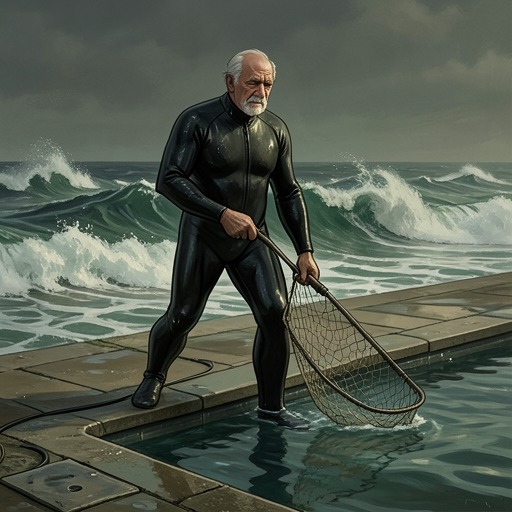
Marcellus’s 18-Minute Limit
Remarkably Bright CreaturesMarcellus’s 18-Minute Limit is the period he has determined he can survive out of water before The Consequences set in. It governs how far he can range from his tank and how much time he can spend foraging, making escape both a repeated exercise in freedom and a tightly constrained survival problem. The limit is not printed on the plaque beside his tank; Marcellus has established it himself, through experience.
How the Limit Works
Once Marcellus slides down the glass into the pump room behind his tank, a clock begins to run. He must resubmerge within eighteen minutes. The rule is practical rather than publicly posted: the aquarium’s plaque does not disclose it, and Marcellus presents the duration as knowledge he has determined on his own. That distinction makes the limit part of his private understanding of his captivity, not an instruction given to visitors or a safeguard maintained by the aquarium.
The threshold shapes the choices he makes as soon as he reaches the concrete floor. He can remain in the pump room, near his own tank and those around it, or breach the door and gain access to the hallway and main tank. Staying close limits the range of food available. The nearby Wolf eels are too dangerous to approach; the Pacific sea nettles are too spicy, the yellow-bellied ribbon worms too rubbery, and the bay-blue mussels unappealing. Sea cucumbers are tempting, but taking more than a few could draw Terry Bailey’s attention. Even foraging within the pump room therefore requires restraint: more time or more food can increase the risk of discovery.
The Cost of Going Farther
Opening the door offers a more varied menu, but the route consumes part of Marcellus’s short window. The heavy door will not stay ajar by itself, so he must spend several minutes opening it on the way out and several more reopening it on his return. The rule thus measures more than the time spent outside the tank. It makes access itself costly, forcing Marcellus to weigh the additional food and territory against the minutes needed to get back into the water.
His attempt to avoid that cost by propping the door with a stool fails. He returns to find that the stool has not held it; by the time he works the door open, The Consequences are already in full effect. The failed prop converts a seemingly small convenience into a decisive danger. Marcellus’s later rule against trusting a propped door comes not from abstract caution but from this direct encounter between the door’s weight, the ticking limit, and his body’s deterioration.
What Happens When Time Runs Out
During the episode, Marcellus’s limbs move slowly and his vision blurs. His mantle grows heavy and droops toward the floor, while his flesh pales to a flat brownish gray. As he crawls across the pump room, he can no longer register temperature; his suckers fumble against the glass. When he works his tentacles and mantle through the gap, they are numb. The account presents the limit through a sequence of lost capacities, rather than as a number alone: movement, sight, sensation, and bodily control all fail while he is still trying to reach the water.
At the opening, Marcellus pauses above the surface, his tentacles without sensation, and considers the possibility of not returning. The moment makes the deadline more than a logistical constraint: crossing it brings him close enough to death that he briefly weighs what might lie beyond life. Yet the water takes him in, and he recovers. His sight sharpens; color returns to his flesh; he can use a tentacle to replace the pump and close the gap, then swim strongly to his den behind the rock. After eating halibut, he rests as his three hearts beat with relief. The return shows the limit in both directions: outside the water he deteriorates, while resubmersion restores his strength and perception.
Repetition, Secrecy, and Significance
The incident is not Marcellus’s only experience of The Consequences. He says that other occasions have followed when he pushed the boundaries of his freedom, though the account gives no further durations or details for them. What changes after the failed door prop is narrower and concrete: he never again relies on those extra few minutes by propping it open. The eighteen-minute limit continues to frame his escapes, but the lesson of the stool adds a practical rule about the route back.
The limit also belongs to a secret system of movement. Marcellus keeps the gap behind his tank hidden from Terry Bailey and says that no one else knows of it. His private knowledge of how long he can survive outside the tank is part of that hidden routine: a measure he has worked out for himself, applied while choosing where to forage, and tested at terrible cost. The account’s first-person explanation addresses the reader directly, but its appeal for discretion preserves the boundary Marcellus has drawn around his escape. The rule marks the danger of his freedom without making that freedom complete: every excursion can take him beyond the tank, but only briefly, and returning in time remains essential.